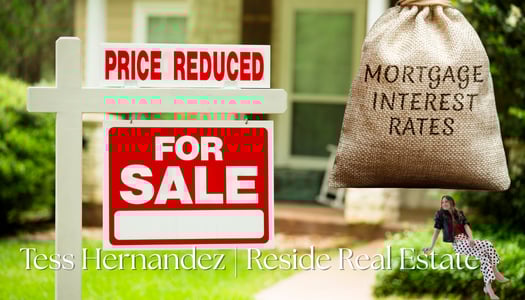
How Does a Mortgage Rate Buydown Compare to a Price Reduction?
In a shifting housing market like Lubbock’s 2025 landscape, buyers and sellers are getting creative. Two of the most common incentives you’ll hear about are rate buydowns and price reductions—and while both save you money, they work in completely different ways.
Let’s break them down.
1. Price Reductions Lower the Purchase Price
A price reduction is straightforward—the seller drops the list price or accepts a lower offer. This immediately reduces your loan amount, property taxes, and closing costs.
Example:
A $400,000 home reduced by $10,000 becomes a $390,000 purchase.
At a 6.75% interest rate, that only drops your monthly payment by about $65–$75.
So while the total cost is lower, the monthly impact may be smaller than you’d expect.
2. Rate Buydowns Lower the Interest Rate (Temporarily)
A rate buydown, on the other hand, uses seller or builder funds to temporarily reduce your mortgage rate for the first few years of the loan—commonly through a 2-1 buydown (2% lower the first year, 1% lower the second).
That same $400,000 loan with a 2-1 buydown could drop your first-year payment by $500–$600 per month, depending on the loan terms.
In other words:
A price reduction helps your total purchase.
A buydown helps your monthly comfort.
3. Which One’s Better?
It depends on your goals.
✅ Choose a buydown if:
You want lower payments now and plan to refinance later.
You’re confident rates will drop in the next few years.
You’d rather boost short-term affordability than long-term savings.
✅ Choose a price reduction if:
You’re buying for the long haul and want the smallest total loan possible.
You’re putting more money down and value smaller property taxes over time.
You plan to stay in the home well beyond five years.
As your Realtor, I evaluate both scenarios with local lenders so my clients can see the real-world difference—payment by payment. In some cases, we even negotiate a hybrid approach, combining a modest price cut with a 2-1 buydown to maximize impact.
The key isn’t choosing one—it’s understanding which fits your strategy.
In today’s Lubbock market, the right structure can make the difference between “comfortable” and “stretching.”
— Insights from Tess Hernandez, Realtor | Reside Real Estate

The person selling you the home and the person representing that seller in the transaction are the same person. Here is what Texas law requires in this situation, what… Read more

You just found out the listing agent is the seller's mom. Can they do that? Does it have to be disclosed? What does it mean for your offer? Here is what Texas law actu… Read more

You had a showing scheduled. The listing agent called and said they already accepted a contract. Nobody gave you a chance to move up the timeline, make a competing off… Read more

Going active on the MLS while telling buyers they cannot see the home for a week sounds like a strategy. In most cases it is the opposite. Here is what actually happen… Read more

They loved it but picked another house. The kitchen was not their style. No feedback at all. If that is all you are hearing after showings you are not alone and there … Read more
A friend had a nightmare with the same builder. You love the home. Here is how to evaluate that situation honestly, what questions to ask, and how to protect yourself … Read more
You found a spec home that is almost perfect but you want different flooring, an extra outlet in the garage, or a different cabinet color. Here is exactly how much fle… Read more
You walked into a new construction community, saw the price sheet, and immediately wondered why there is no room to negotiate the way you would with a resale home. Her… Read more
You came home to find every light in the house blazing, the back door unlocked, and the garage door wide open. Nobody stayed behind on purpose. They just left without … Read more
Get assistance in determining current property value, crafting a competitive offer, writing and negotiating a contract, and much more. Contact me today.
TESS HERNANDEZ
6901 Quaker Ave Ste 100 Lubbock, TX 79413